

Blog
The Psychology of Clarity: Why Clear Thinking Leads to Better Decisions

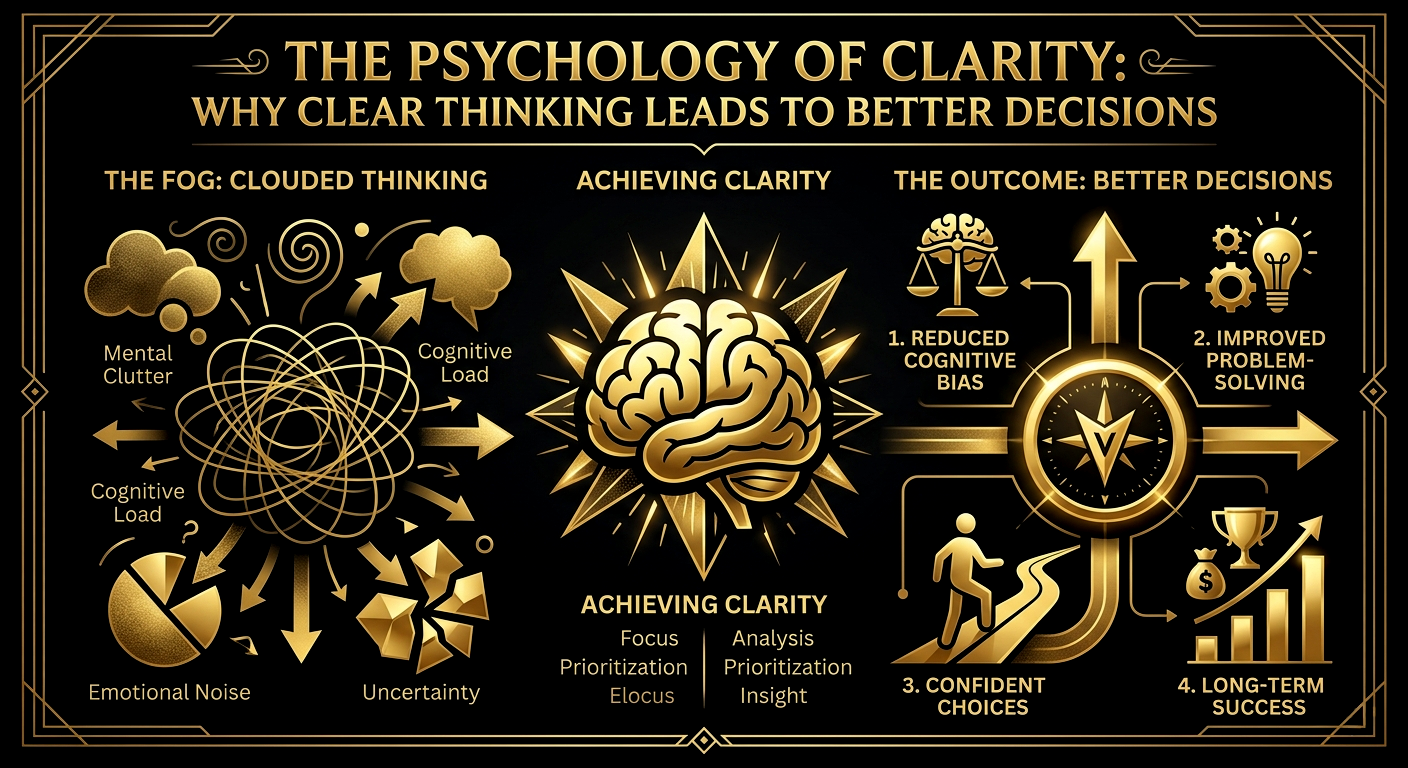
Clarity isn’t just a feeling — it’s a psychological state where emotions, thoughts, and intentions align. Most confusion comes from competing inner voices: fear, expectation, habit, and hope. When these overlap, decisions become difficult and outcomes feel uncertain.
The real issue is not that people lack answers — it’s that their mind is too noisy to trust them.
At Crystalamp, clarity begins with structure. By slowing down the mind and focusing on one concern at a time, you reduce emotional pressure and create space for rational insight. This shift not only reveals what truly matters but also allows you to act with confidence rather than hesitation.
Clear thinking isn’t about knowing everything. It’s about removing noise until the right direction becomes obvious.
The Illusion Most People Live In
Most people believe they are thinking clearly because they are constantly thinking.
But thinking and clarity are not the same thing.
Thinking can be:
- repetitive
- emotional
- fear-driven
- influenced by outside opinions
Clarity, on the other hand, is filtered thinking. It is what remains after unnecessary thoughts are removed.
The problem is, most people never filter their thoughts — they multiply them.
That’s why the same problem stays in their mind for weeks, sometimes months, without resolution.
Not because the problem is complex, but because the mind is unorganized.
Why the Mind Creates Confusion on Purpose
This is where most people misunderstand themselves.
The mind does not always want clarity.
Because clarity forces:
- decisions
- endings
- accountability
- emotional discomfort
So instead of giving a clear direction, the mind creates more scenarios.
It says:
- “Think a little more”
- “Maybe there’s another option”
- “What if you’re wrong?”
This is not intelligence. This is avoidance disguised as logic.
And the longer you listen to it, the more exhausting everything becomes.
The Difference Between Thinking and Overthinking
Thinking is structured. Overthinking is circular.
- Thinking moves toward a decision
- Overthinking avoids a decision
In thinking, each thought brings you closer to action.
In overthinking, each thought creates another question.
That’s why overthinking feels productive — but produces nothing.
You feel busy in your mind, but your situation doesn’t change.
Emotional Weight Behind Unclear Decisions
Every unclear decision carries emotional weight.
Even if you don’t notice it consciously, your mind feels:
- pressure
- fear of wrong choice
- fear of regret
- fear of judgment
So instead of deciding, you delay.
But here is the hidden truth:
Delay does not remove pressure. It multiplies it.
A small decision today becomes a heavy burden tomorrow.
Why Clarity Feels Uncomfortable at First
Clarity is not always calming.
At first, it can feel confronting.
Because clarity removes excuses.
When something becomes clear, you cannot say:
- “I’m still figuring it out”
- “I need more time”
- “It’s complicated”
Clarity turns confusion into responsibility.
That is why many people unconsciously resist it.
Not because they don’t want answers — but because they don’t want consequences.
How Clear Thinking Actually Happens
Clear thinking is not a natural state. It is a trained state.
It happens when you:
1. Reduce mental input
Stop feeding your mind unnecessary opinions, fears, and scenarios.
2. Focus on one question only
Not multiple angles. Not future outcomes. One real question.
3. Separate emotion from fact
Ask: “What is real vs what am I afraid of?”
4. Force simplification
Every complex situation always has a simple core truth.
When you reach that core, clarity appears.
Why External Guidance Changes Everything
When you are inside your own confusion, you cannot see it objectively.
That is why people stay stuck — not because they lack intelligence, but because they are too emotionally involved in their own situation.
An external perspective helps because it:
- removes emotional bias
- simplifies patterns you cannot see
- asks the question you avoid
- reflects truth without distortion
This is where structured guidance becomes powerful — it doesn’t give you new reality, it removes your distortion of it.
The Moment Everything Becomes Clear
There is always a specific moment when clarity appears.
It feels like:
- silence in the mind
- reduced emotional tension
- one option suddenly standing out
- other options losing importance
That moment is not random.
It happens when mental noise finally drops below a threshold.
And suddenly, what felt complicated becomes simple.
Final Thought
Clarity is not about finding answers outside yourself.
It is about removing everything that is making the answer unclear inside you.
Most people are not lost.
They are just overwhelmed by unnecessary thinking.
And once that noise is removed, the right direction doesn’t need effort — it becomes obvious.