

Blog
The Clarity Gap: Why You Feel Stuck Even When You Know the Truth

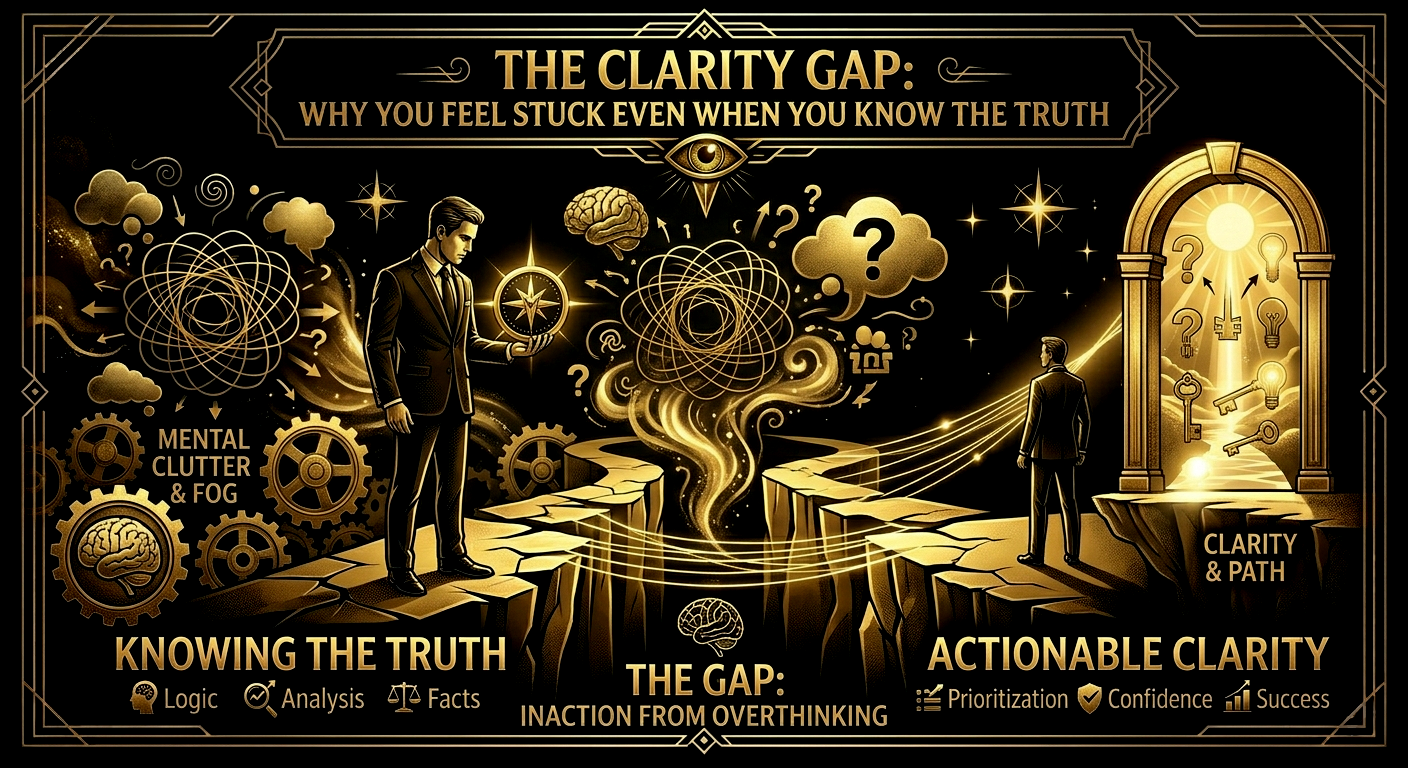
Often, people already know what they need to do — but hesitation, fear, or doubt creates a gap between understanding and action.
This “clarity gap” is one of the most common psychological blocks in decision-making. It does not come from lack of knowledge. It comes from emotional resistance to what is already known.
At Crystalamp, this gap is identified quickly in sessions. Clients often realize that they are not confused — they are conflicted. And once that conflict is exposed, decisions become significantly easier to make.
The clarity gap closes the moment internal resistance reduces and action becomes unavoidable.
Why Knowing the Truth Is Not Enough
One of the biggest misconceptions in decision-making is this:
“If I understand it, I will act on it.”
But understanding does not automatically lead to action.
You can:
- know a relationship is unhealthy
- know a decision is overdue
- know a situation is not working
And still do nothing.
Why?
Because awareness and acceptance are two different states.
What Actually Creates the Clarity Gap
The clarity gap forms when two forces collide:
- Logical understanding: “This is what needs to be done.”
- Emotional resistance: “I don’t want to face what comes after.”
This conflict creates internal paralysis.
You are no longer confused about the answer.
You are uncomfortable with the consequence.
So the mind creates delay to avoid discomfort.
The Silent Pattern Behind Being “Stuck”
When people say they are stuck, they usually mean:
- “I keep thinking about it but not acting”
- “I know what I should do but I can’t decide”
- “I need more time to be sure”
But in reality, these are signs of internal resistance — not confusion.
Stuckness is not a lack of direction.
It is a refusal to move in a direction you already understand.
How the Mind Maintains the Gap
The mind does not close the clarity gap easily.
Instead, it tries to protect it by:
- overthinking
- seeking reassurance
- imagining alternative outcomes
- delaying decisions
- revisiting the same thoughts repeatedly
This creates the illusion of progress without actual movement.
You feel busy mentally, but nothing changes externally.
Why the Gap Feels So Real
The clarity gap feels real because it creates emotional tension.
You experience:
- mental pressure
- indecision fatigue
- emotional conflict
- repeated doubt cycles
This makes you believe the problem is complexity.
But the real issue is emotional discomfort with action.
What Happens When the Gap Closes
The moment the clarity gap closes, something shifts immediately:
- thinking becomes simple
- decisions feel obvious
- emotional pressure drops
- action no longer feels forced
You don’t gain new information.
You lose internal resistance.
And that is what creates clarity.
How to Reduce the Clarity Gap
You don’t solve the clarity gap by thinking more.
You solve it by removing resistance.
Start here:
- Identify what outcome you are afraid of
- Separate fear from actual facts
- Reduce overanalysis time
- Force decisions into simple yes/no structure
- Stop revisiting already understood answers
The goal is not certainty.
The goal is movement.
Why External Guidance Helps
When someone is inside their own clarity gap, objectivity disappears.
That is why external perspective is powerful — it:
- highlights what is already known
- exposes emotional avoidance
- simplifies decisions into clarity
- reduces mental distortion
This is not about giving answers.
It is about removing what is blocking the answer from being acted on.
Final Thought
You are not stuck because you don’t know the truth.
You are stuck because you are not willing to act on it yet.
The clarity gap is not a thinking problem.
It is a resistance problem.
And once resistance is removed, action stops feeling difficult — it becomes the only logical next step.