

Blog
The Power of Asking Better Questions: How Clarity Begins With Precision

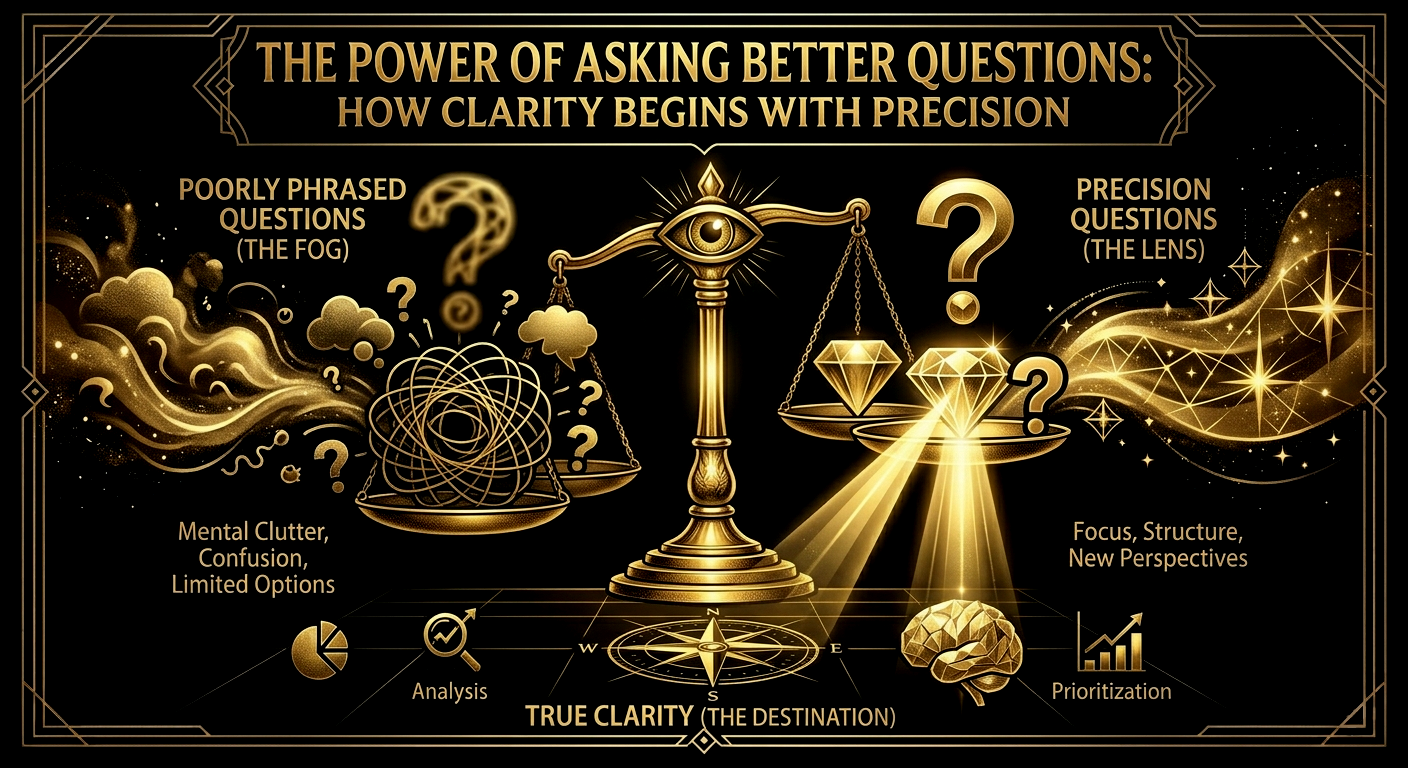
Every accurate answer begins with a precise question. When your question is broad, vague, or emotionally charged, the insight you receive will also feel unclear.
Most people don’t realize this — but the quality of your thinking is determined before the answer ever arrives. It is determined by the question you ask.
At Crystalamp, sessions focus on refining the question before answering it. Because a poorly framed question creates confusion even if the answer is correct.
For example, instead of asking:
“What will happen in my relationship?”
A clearer question is:
“What is the best next step I should take in my relationship right now?”
This shift removes fear-based thinking and replaces it with direction.
A precise question sharpens focus, removes assumptions, and produces answers that are practical and actionable.
Clarity is not found — it is shaped by the questions you ask.
Why Most People Ask the Wrong Questions
Most people don’t ask questions to find truth.
They ask questions to reduce anxiety.
That’s why their questions are often:
- vague
- emotional
- future-focused
- fear-driven
Examples:
- “Will everything be okay?”
- “Is this meant for me?”
- “What will happen next?”
These questions don’t create clarity.
They create uncertainty disguised as curiosity.
Because they are not designed to produce action.
The Hidden Problem Behind Vague Questions
A vague question protects you from a direct answer.
Why?
Because a clear question often leads to a clear truth — and clear truth demands responsibility.
So instead of asking:
“Should I leave this situation?”
People ask:
“Why am I feeling like this?”
It feels safer.
But it keeps you stuck.
Vagueness is often avoidance in disguise.
How Your Questions Shape Your Mind
Your mind does not think randomly.
It responds to the question you feed it.
If your question is unclear, your thinking becomes:
- scattered
- emotional
- repetitive
- circular
If your question is precise, your thinking becomes:
- structured
- focused
- solution-oriented
- actionable
So the problem is not lack of answers.
It is lack of direction in thinking.
Emotional Questions vs Strategic Questions
There are two types of questions people ask:
Emotional Questions
- “Why is this happening to me?”
- “What if I make the wrong decision?”
- “Will I be okay?”
These questions come from fear and uncertainty.
They do not lead to action.
Strategic Questions
- “What is the next step I should take?”
- “What is within my control right now?”
- “What decision reduces future regret?”
These questions create movement.
They turn confusion into structure.
Why Clarity Feels Instant After the Right Question
Have you noticed that sometimes clarity appears suddenly?
It is not random.
It happens when the right question is finally asked.
Because the brain immediately shifts from:
“What is happening?”
to
“What should I do about it?”
That shift changes everything.
The answer was always there — the framing was missing.
How to Start Asking Better Questions
If your current thinking feels unclear, don’t look for answers first.
Fix your questions first.
Start here:
- Reduce one problem into one question
- Remove emotional words like “always,” “never,” “why me”
- Focus on present action, not future uncertainty
- Ask questions that lead to decisions, not reflection
- Keep the question so simple that it cannot be misinterpreted
If a question does not lead to action, it is not useful.
Why People Avoid Precision
Precision is uncomfortable.
Because it removes escape routes.
A precise question forces:
- clarity
- truth
- accountability
- decision
That is why people often prefer vague thinking — it keeps options open.
But open options also mean open confusion.
Final Thought
You are not lacking answers.
You are asking the wrong questions.
And the moment your question becomes clear, your thinking stops being complicated.
Because clarity does not come from more thinking.
It comes from better direction.